Every culture that has painted the naked body has had to answer one question first: where did the nude come from? Greece said the gods made it. Christianity said God made it, and then it fell. Ovid told a different story. In the Metamorphoses, a sculptor named Pygmalion grew so disgusted with the women of Cyprus that he swore off living flesh and carved his own perfect woman out of ivory. He dressed her, laid her on a couch, brought her gifts, and fell in love with her. At the festival of Aphrodite he prayed for a bride like his statue. When he returned home and kissed her, the ivory softened to skin.
That story is the nude’s truer origin. The sculptor does not discover the ideal body in nature. He manufactures it, and then he desires what he has made. Every academic nude that followed inherited that double gesture: the artist builds the body and the body returns his gaze. This is the myth that named the relationship between the male artist and the female nude for two thousand years.
Jean-Léon Gérôme painted the moment itself in 1890. His Pygmalion and Galatea catches the statue mid-transformation, still white from the waist down, warm and living from the hips up, as the sculptor reaches upward to kiss her. Gérôme was the nineteenth century’s great painter of boundaries, and here the boundary is the one that mattered most to him: the line where a made thing becomes a person. The marble does not melt all at once. It surrenders inch by inch, and the kiss is what does the work.
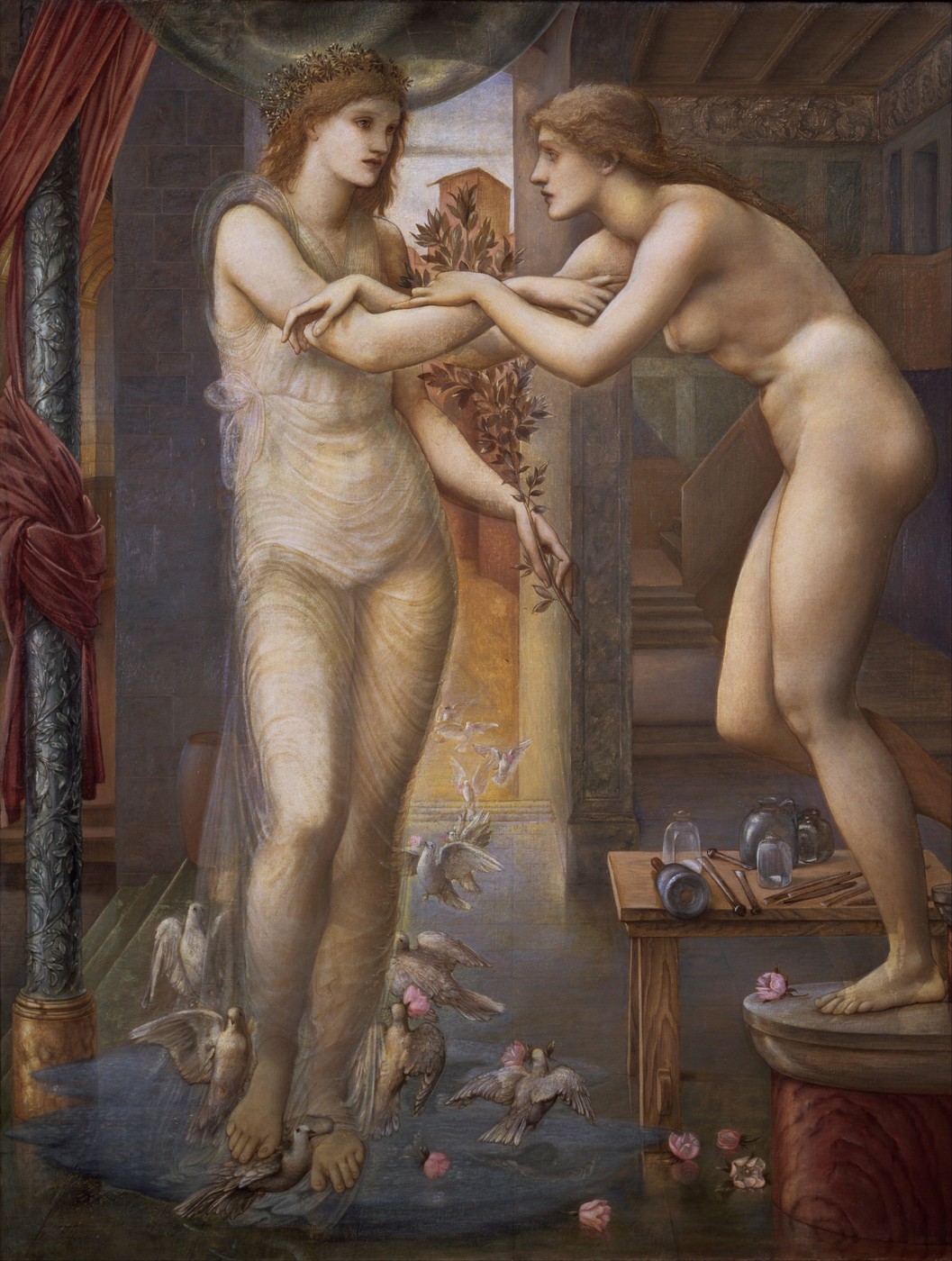
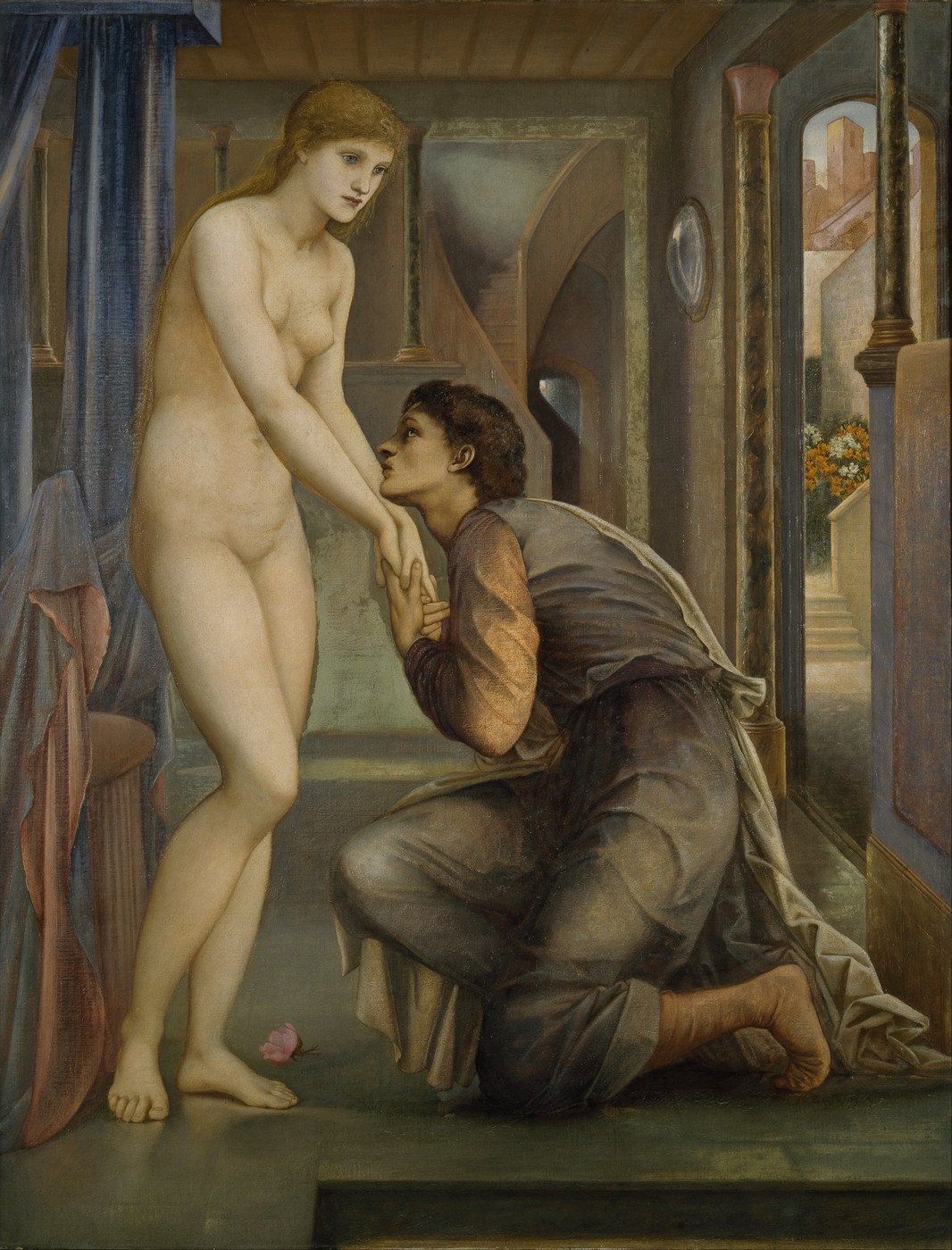
Edward Burne-Jones returned to the same story a decade earlier and spread it across four canvases. His Pygmalion and the Image series, painted between 1868 and 1878, begins with the sculptor brooding before his perfect figure in The Heart Desires, moves through his restraint in The Hand Refrains, and then lets the gods intervene. In The Godhead Fires, Venus touches the statue and life passes into it. In The Soul Attains, the living Galatea stands before the kneeling sculptor. Burne-Jones recast Ovid’s erotic fable as a spiritual allegory about the soul waking inside the flesh, which is exactly the question every nude painting asks.
The myth has a shadow, and it is worth naming. Galatea never speaks in Ovid. She has no mother, no history, no desire of her own. The sculptor manufactured her, and her only purpose is to be loved by the man who made her. That silence is the Western nude’s oldest habit. For centuries the female body in art was a thing men fabricated and then admired, an object that existed to receive a gaze it could never return. Pygmalion is the story that makes that arrangement look like romance.
Yet the myth cuts the other way too. The artist’s love is what turns the object into a person. The moment the ivory warms, the statue stops being a thing and starts being someone. Every painter who has given a nude a face, a mood, an inner life has repeated Pygmalion’s gamble: that if you look at a body long enough and honestly enough, it will look back. The nude is both the body the artist made and the body he hoped would answer him.
That hope is why the myth has never left the studio. From Gérôme’s polished academicism to Burne-Jones’s dreamlike series, artists keep painting the instant of awakening because it is their own moment too. They set down a shape and wait to see whether it will come alive. Galatea is the patron saint of every unfinished canvas and every form that refuses to stay still.
Want to see how today’s artists still wrestle with the made body and the living one? Join the conversation at nudeartla.com.