Before the Scalpel, the Body Was a Symbol
\n
For centuries before the Renaissance, the nude human figure in Western art was not really a body at all \u2014 it was an idea. Medieval painters rendered flesh as a spiritual vessel, elongated, weightless, obedient to theology rather than gravity. The nudity of Adam and Eve in a Gothic manuscript was a theological statement, not an anatomical one. The body was a symbol of sin, of virtue, of the soul’s journey \u2014 but never a body of bone, muscle, and sinew.
\n
Then, in the early fifteenth century, something changed. Artists began to look under the skin.
\n
The Renaissance transformation of the nude \u2014 from schematic form to breathing, weight-bearing flesh \u2014 was not primarily a stylistic choice. It was an anatomical revolution. And it happened not in the studio alone, but in the dissection chamber.
\n\n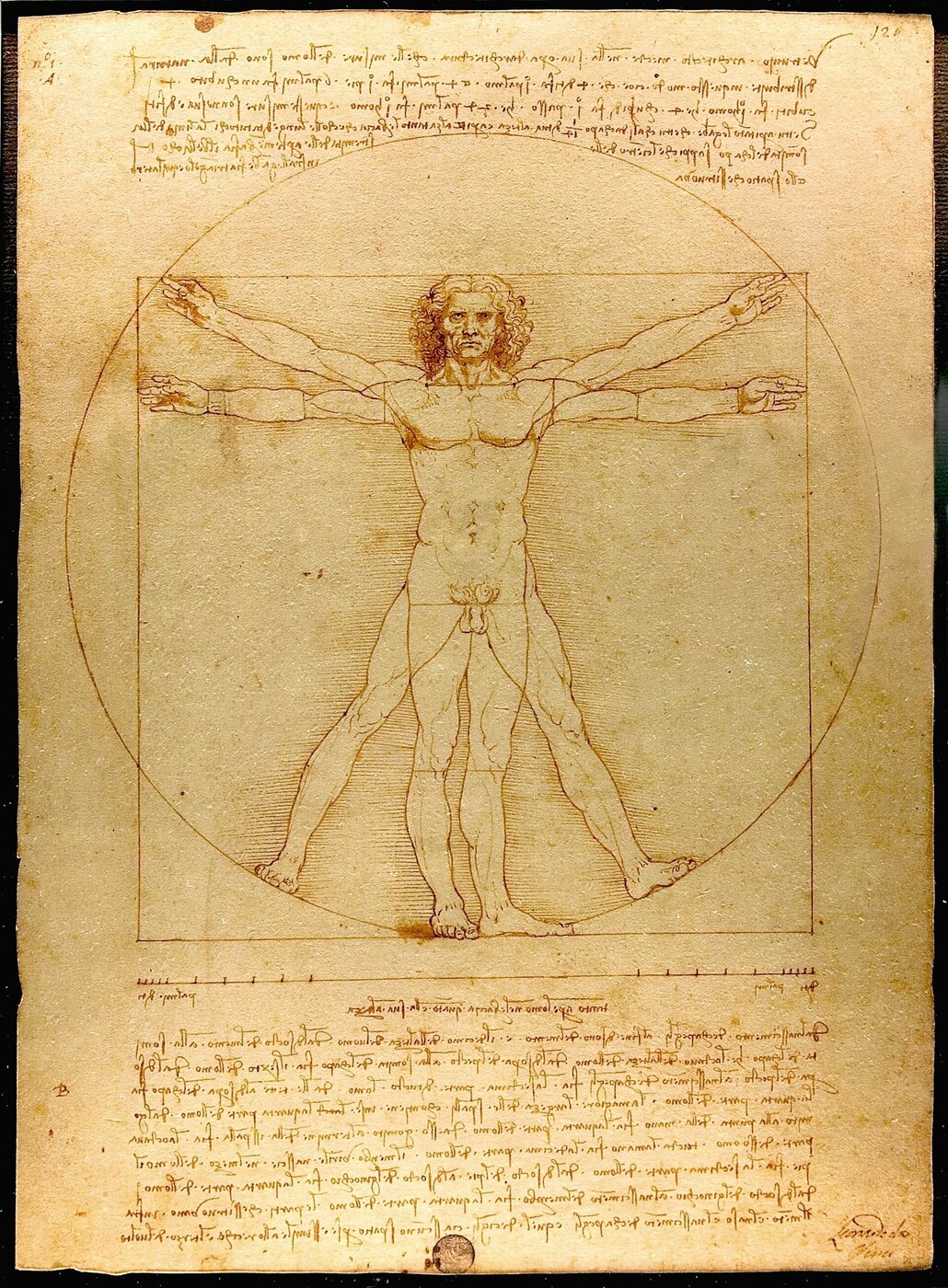 \n
\n
Leonardo da Vinci, Vitruvian Man (c. 1490), pen and ink on paper. Gallerie dell’Accademia, Venice. Public Domain.
\n\n
The Artist as Anatomist
\n
The critical shift began with the rediscovery of classical sculpture, which offered Renaissance artists a model of the body they could no longer ignore. Greek and Roman marbles revealed muscles, tendons, and proportions that medieval painting had flattened into insignificance. But sculpture could only show surfaces. To understand why the human body looked the way it did \u2014 why the deltoid swelled when the arm lifted, why the spine curved in contrapposto \u2014 artists needed to see what was underneath.
\n
By the late fifteenth century, Florentine artists were attending public dissections. Antonio Pollaiuolo, whose engraving Battle of the Nudes (c. 1470) was the first Italian print to display systematic musculature, reportedly dissected corpses himself. Luca Signorelli filled the frescoes of Orvieto Cathedral with nudes whose torsos bore the marks of anatomical study \u2014 each rib visible, each abdominal muscle individually articulated.
\n
But the man who took the practice furthest was Leonardo da Vinci.
\n\n
Leonardo: Drawing the Interior
\n
Between 1489 and 1513, Leonardo dissected more than thirty human cadavers \u2014 in secret, at night, often in defiance of church restrictions. He worked in the hospital of Santa Maria Nuova in Florence and later in Milan and Rome, documenting everything he found in hundreds of sheets now known as the Anatomical Manuscripts.
\n
Leonardo’s anatomical drawings are remarkable not just for their accuracy but for their vision. He did not simply record what he saw; he translated dissection into art. His studies of the muscles of the shoulder, the bones of the hand, the layers of the neck \u2014 each drawing is also a composition, a study in how form and function meet.
\n
In his famous Vitruvian Man (c. 1490), Leonardo took the Roman architect Vitruvius’s description of ideal human proportions \u2014 that the span of the outstretched arms equals the height, that the navel is the center of the circle containing the body \u2014 and rendered it as a vision of the body in perfect balance. It is both an anatomical diagram and a philosophical statement: the human figure as the measure of all things.
\n\n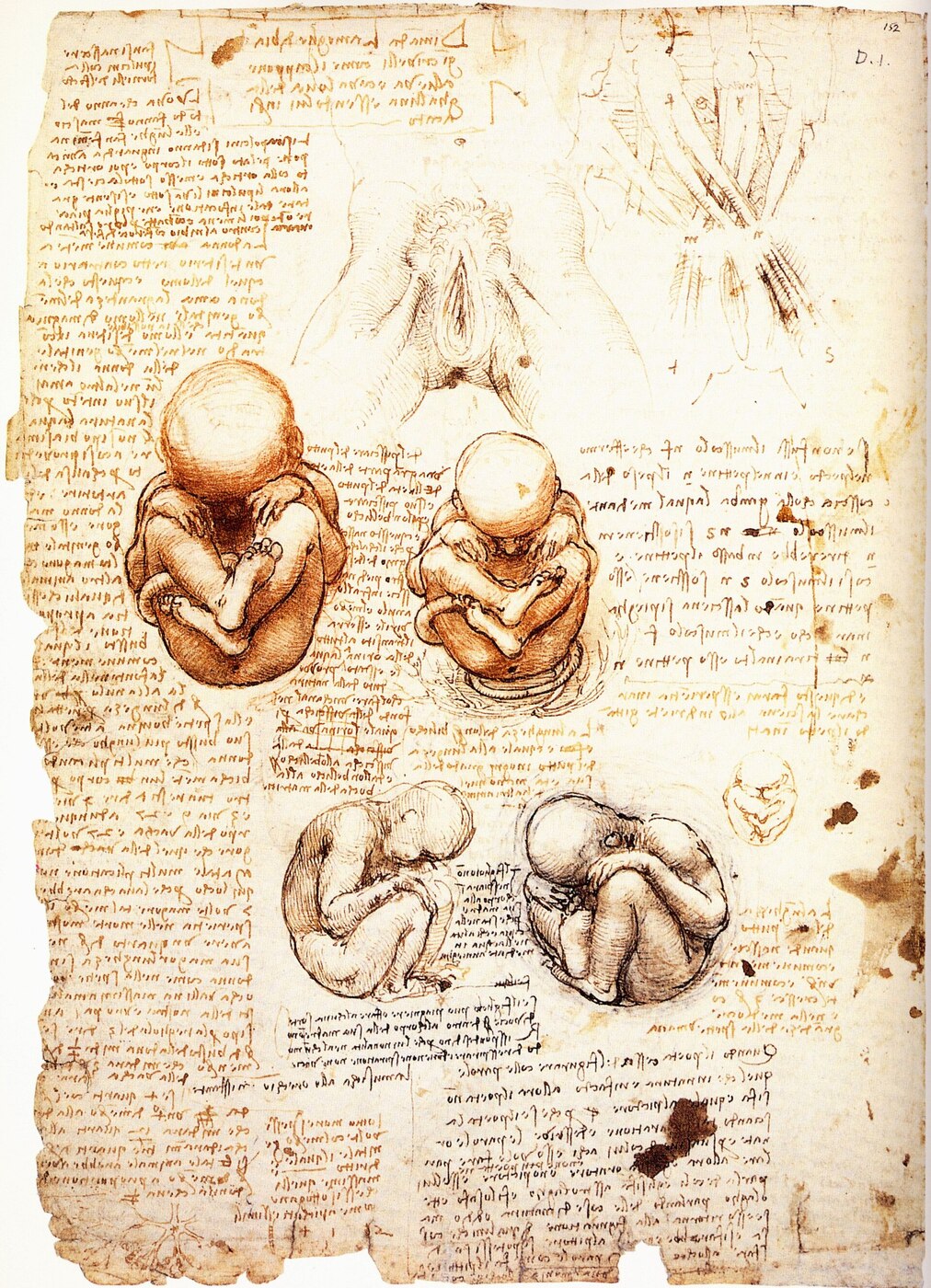 \n
\n
Leonardo da Vinci, Studies of the Fetus in the Womb (c. 1510-1513), red chalk and ink on paper. Royal Collection Trust. Public Domain.
\n\n
His Studies of the Fetus in the Womb (c. 1510) goes further, revealing Leonardo’s fascination with the body’s origins. He dissected a pregnant cow \u2014 possibly a human uterus obtained at autopsy \u2014 to show the fetus curled within, surrounded by layers of membrane. It is one of the first accurate depictions of human fetal positioning in Western art, and it treats the unborn body with the same reverent precision Leonardo applied to every subject.
\n
Leonardo’s anatomical work was never published in his lifetime. His notebooks lay dormant for centuries. But the drawings themselves \u2014 the way he saw the body as a machine of exquisite complexity \u2014 influenced every artist who encountered them.
\n\n
Vesalius: The Body in Print
\n
One generation after Leonardo, the Flemish physician Andreas Vesalius published De Humani Corporis Fabrica (On the Fabric of the Human Body, 1543), a seven-volume masterwork that transformed anatomy from folk knowledge into empirical science. The Fabrica was illustrated with woodcuts of extraordinary beauty \u2014 flayed figures striking classical poses, their muscles peeled back layer by layer, their tendons exposed against backgrounds of the Italian countryside.
\n
The illustrations were produced by artists in the workshop of Titian \u2014 possibly Titian’s pupil Jan van Calcar \u2014 and they mark the moment when anatomy and art become inseparable. These “muscle men” do not look like cadavers. They stand, walk, and gesture like living beings, their exposed musculature a kind of second skin. The Fabrica became the definitive anatomical text of the early modern period \u2014 and an art book in its own right.
\n
What Vesalius gave artists was not just information but permission. The body could be studied empirically, measured, dissected, understood. And that understanding could be turned back into art.
\n\n
Michelangelo: The Body as Architecture
\n
Michelangelo Buonarroti, who began dissecting cadavers in his teens at the church of Santo Spirito in Florence, took anatomical knowledge in a different direction. Where Leonardo drew the body as a machine, Michelangelo built it like a building \u2014 each muscle a beam, each ligament an arch.
\n
His preparatory drawings reveal an artist who could construct a human figure from the inside out. In the Study for the Libyan Sibyl (c. 1511), a red-chalk drawing made in preparation for the Sistine Chapel ceiling, Michelangelo renders a female figure seen from behind, her torso twisted, her shoulder blades visible beneath the skin. It is simultaneously an anatomical study and a monument of grace \u2014 the body understood so completely that structure becomes poetry.
\n\n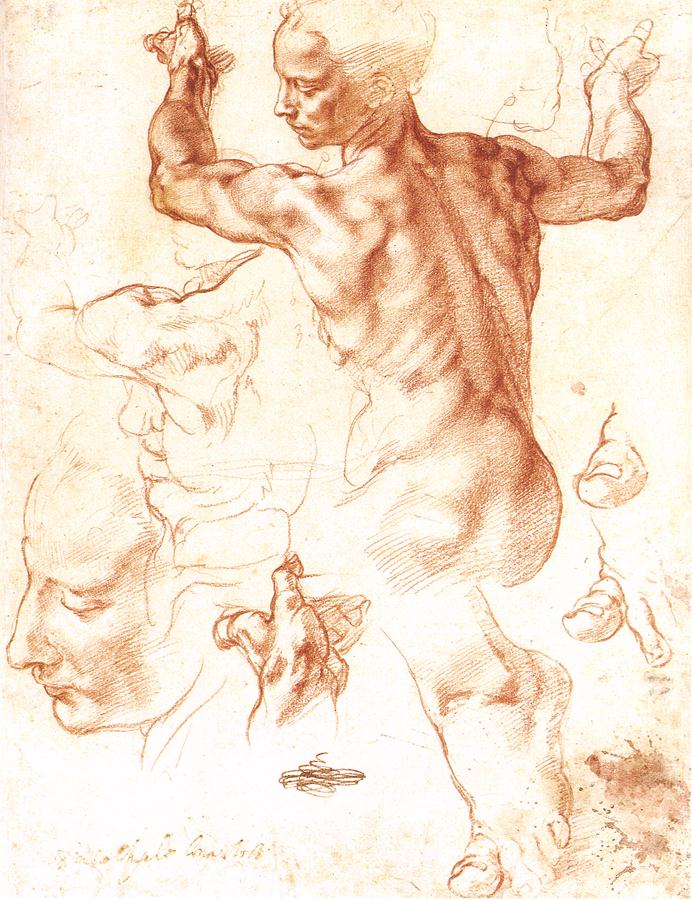 \n
\n
Michelangelo Buonarroti, Study for the Libyan Sibyl (c. 1511), red chalk on paper. Metropolitan Museum of Art, New York. Public Domain.
\n\n
Michelangelo’s Sistine Chapel nudes \u2014 the ignudi, the sibyls, Adam himself \u2014 could not exist without his anatomical training. The way Adam’s arm reaches toward God, the way the Libyan Sibyl’s spine spirals as she reaches for her book: these are not poses invented in the imagination. They are poses discovered through an intimate knowledge of what the body can do.
\n
Michelangelo’s dissections at Santo Spirito were so extensive that the prior of the monastery allowed him to keep the cadaver for days \u2014 a rare privilege that the artist repaid by carving a wooden crucifix for the church. That crucifix still hangs in Santo Spirito today, a reminder that the study of death was, for Michelangelo, the study of life.
\n\n
The Legacy: Every Nude After
\n
The anatomical revolution of the Renaissance did not end with Leonardo, Vesalius, and Michelangelo. It became the foundation of Western art education. By the seventeenth century, life-drawing academies across Europe required students to study anatomy before they could draw the living model. Mondino de’ Liuzzi‘s fourteenth-century anatomy text was reprinted for artists. Albrecht D\u00fcrer published his own treatise on human proportions (1528), applying Renaissance measurement to Northern European figure drawing. Charles Le Brun, official painter to Louis XIV, gave lectures on the anatomy of expression \u2014 how each muscle of the face communicates emotion.
\n
When the French Academy required students to draw from antique casts before they were allowed near the living model, they were enacting a curriculum that began in the dissection chamber. The nude in art \u2014 from Poussin’s mythological scenes to Ingres’s odalisques to Rodin’s walking men \u2014 carries the DNA of those Renaissance anatomists who were not content to draw the surface.
\n
They wanted to know what was underneath.
\n\n
The Body as Knowledge
\n
What the Renaissance anatomists understood \u2014 and what every great draftsman since has known \u2014 is that drawing the nude is an act of knowing. You cannot render the human body convincingly by copying its outline. You must understand its architecture, its mechanics, its hidden structure. The flexor digitorum profundus that bends the fingers. The sartorius that spirals across the thigh. The scapula that slides beneath the trapezius when the arm rises.
\n
The Renaissance gave us not just the vocabulary of the nude but the grammar \u2014 the underlying logic that makes the surface meaningful. Every time an artist draws a figure from life, they are repeating the gesture Leonardo made in the dissection chamber: reaching past the surface to find the truth beneath.
\n
And the body, understood this way, is more beautiful \u2014 not less. Knowledge does not diminish wonder. It deepens it.
\n