On June 17, 1898 \u2014 128 years ago today \u2014 Sir Edward Coley Burne-Jones died at his London home, The Grange in Fulham. He left behind a body of work that transformed the nude from a classical exercise into something dreamlike, melancholic, and profoundly spiritual. In an era when the English art establishment regarded the naked body as either morally dangerous or academically tedious, Burne-Jones made it ethereal \u2014 and in doing so, became the unlikely star of the Aesthetic Movement.
\n\n\n\nFrom Rossetti’s Shadow to His Own Vision
\n\n\n\nBurne-Jones was never a conventional Pre-Raphaelite. While Rossetti painted voluptuous, confrontational nudes that dared Victorian society to look away \u2014 Venus Verticordia, Lady Lilith \u2014 Burne-Jones took a different path. His figures are elongated, almost medieval in their proportions, with pale skin and heavy-lidded eyes that seem to belong to a dream rather than a waking world. Where Rossetti provoked, Burne-Jones invited contemplation.
\n\n\n\nTrained at Oxford alongside William Morris (his lifelong collaborator), Burne-Jones absorbed the Pre-Raphaelite reverence for medieval art and Arthurian legend. But by 1870, he had stripped away the narrative clutter and developed a style uniquely his own \u2014 one that critics would eventually call “the Burne-Jones ideal”: a world where the human body exists in a state of suspended animation, caught between flesh and spirit.
\n\n\n\nThe Wheel of Fortune: Flesh at the Mercy of Fate
\n\n\n\n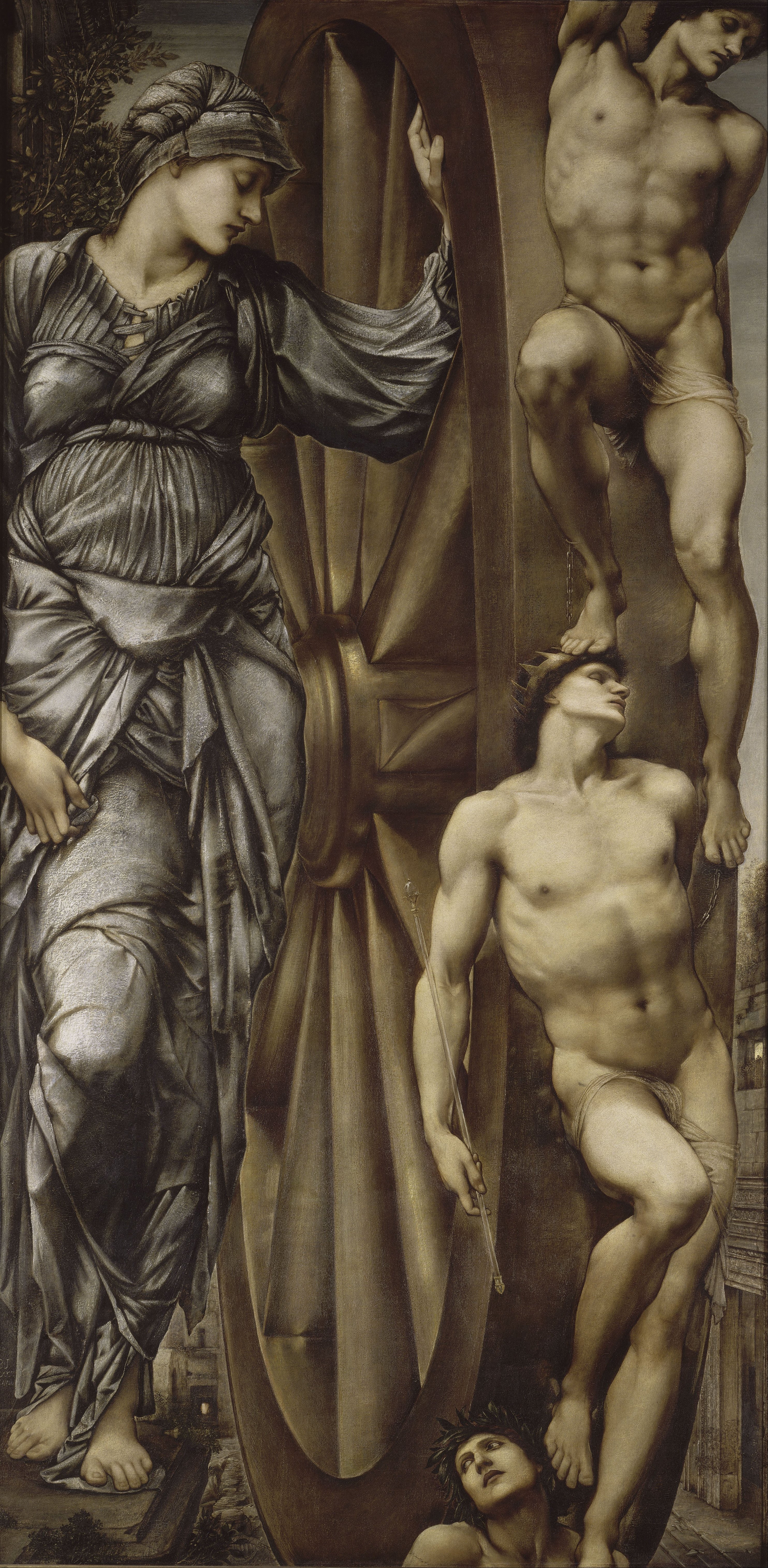
The Wheel of Fortune (1875\u20131883) is arguably Burne-Jones’s most powerful treatment of the nude figure. The painting shows three nude figures bound to Fortune’s great wooden wheel \u2014 one being crushed beneath it, one at the apex of glory, and one falling into obscurity. The bodies are not idealized in the classical sense. Their nudity is not about beauty but vulnerability: stripped of clothes, status, and identity, they are reduced to human beings at the mercy of forces beyond their control.
\n\n\n\nThe painting took eight years to complete \u2014 Burne-Jones was famously obsessive, scraping and repainting until he achieved the exact quality of light and shadow he wanted. The result is a work that feels at once ancient and modern, like a Renaissance fresco dreamed by a Victorian melancholic. The male figure at the bottom, crushed beneath the wheel, is one of the most visceral depictions of suffering in 19th-century British art \u2014 a nude body that expresses anguish not through gesture but through the sheer weight of the composition pressing down upon it.
\n\n\n\nThe Golden Stairs: Nudity as Music
\n\n\n\n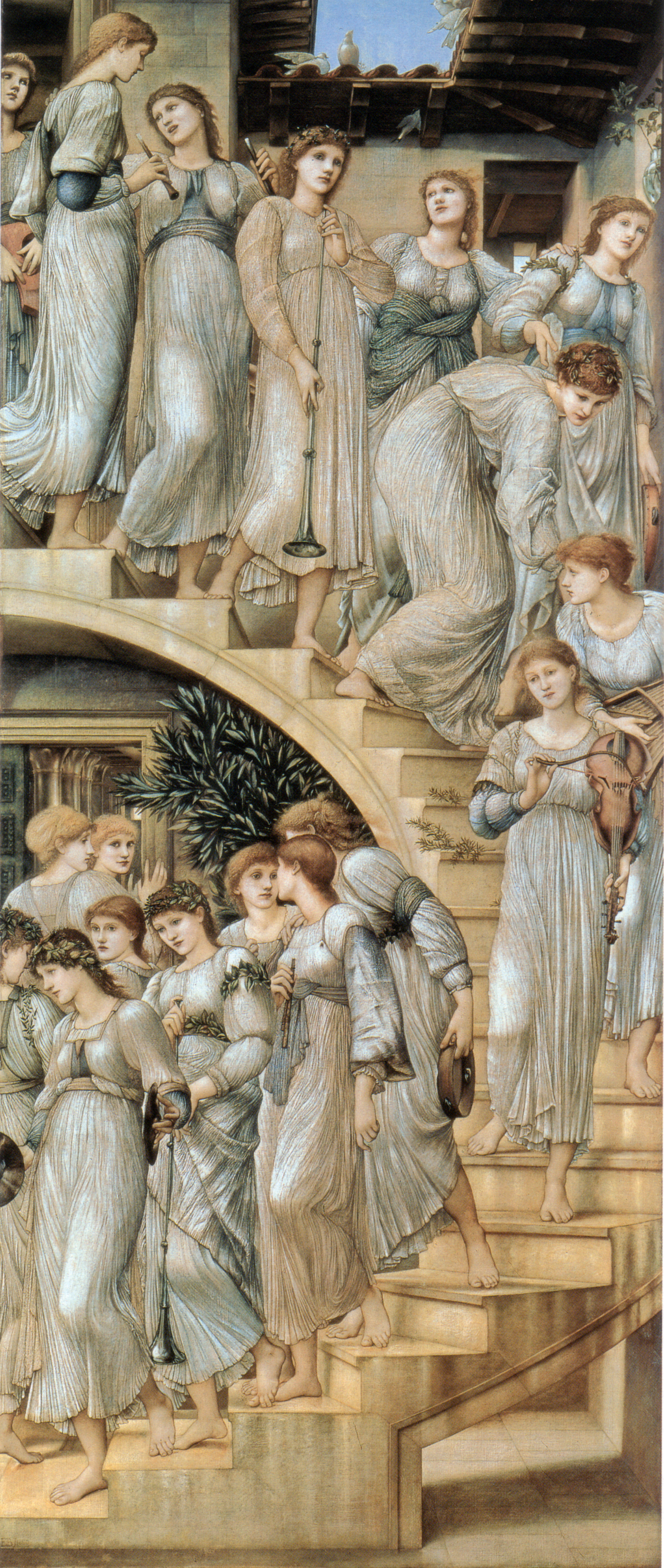
In complete contrast to the violence of The Wheel of Fortune, The Golden Stairs (1880) shows a procession of semi-nude female figures descending a spiral staircase, each carrying a musical instrument. There is no narrative, no recognizable myth, no moral lesson \u2014 just bodies in motion, draped and undraped, moving through a dreamspace of gold and white. The painting scandalized some critics precisely because it refused to mean anything. “A staircase and nothing else,” complained one reviewer. But that was the point.
\n\n\n\nBurne-Jones was a leading figure in the Aesthetic Movement, which championed “art for art’s sake” \u2014 the idea that a painting does not need to teach a lesson, tell a story, or improve its viewer. It simply needs to be beautiful. The Golden Stairs is the purest expression of that philosophy in Victorian painting: the nude body as visual music, stripped of allegory and allowed to exist on its own terms.
\n\n\n\nPygmalion and Galatea: The Nude as Creator’s Obsession
\n\n\n\n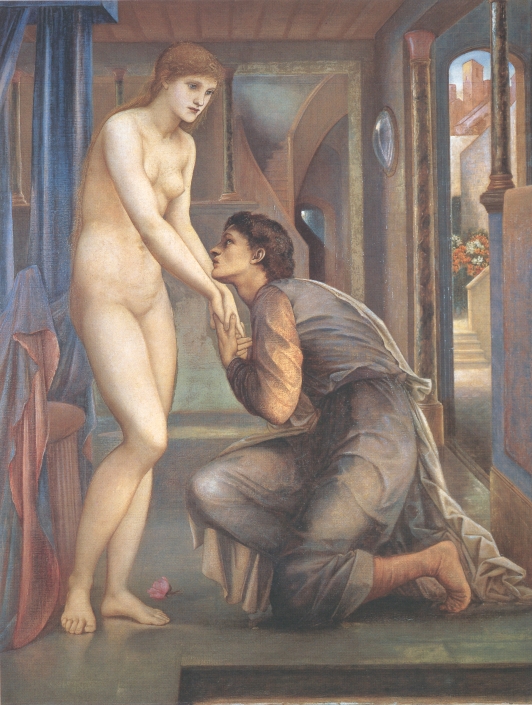
Burne-Jones returned to the Pygmalion myth twice \u2014 first in a series of grisailles (1875) and then in a full-color series (1878). The story of the sculptor who falls in love with his own creation was deeply personal for an artist who spent decades perfecting an ideal of the human form. In The Soul Attains, the fourth painting of the second series, Galatea steps down from her pedestal, her nude body transformed from marble to flesh. Pygmalion kneels before her, and the goddess Venus presides over the metamorphosis.
\n\n\n\nWhat makes Burne-Jones’s Pygmalion series remarkable is that the nude body is treated with the same reverent attention whether it’s carved in stone or alive. Galatea’s body in the first three paintings is cool, white, sculptural \u2014 an idealized form. In the final painting, she is warm, flushed, real. The transition is subtle, barely perceptible at first glance, and that restraint is what makes it so powerful. Burne-Jones is not interested in the sensationalism of a statue coming to life; he is interested in the quiet miracle of art becoming flesh.
\n\n\n\nThe Body Without Alibi
\n\n\n\nOne way to understand Burne-Jones’s contribution to the nude in art is to compare him to his contemporaries. The French Impressionists \u2014 Degas, Renoir \u2014 painted the nude as a creature of flesh, blood, and modern life. The Pre-Raphaelites \u2014 Rossetti, Millais \u2014 painted the nude as allegory or temptation. Burne-Jones did something different: he painted the nude as presence \u2014 a body that does not need to be justified by narrative, morality, or realism.
\n\n\n\nThis is what the Aesthetic Movement meant by “art for art’s sake,” and it is why Burne-Jones’s nudes feel so modern more than a century after his death. His bodies do not explain themselves. They do not apologize. They are simply there, suspended in amber, luminous and strange \u2014 asking us to look without demanding that we understand.
\n\n\n\nLegacy and Looking Forward
\n\n\n\nBurne-Jones died at 64, his health worn down by years of obsessive work. He was buried at Rottingdean, the Sussex village where he kept a country home, with a memorial designed by his friend William Morris. His influence rippled through the Symbolist movement in Europe, through Art Nouveau, and into the 20th century \u2014 Klimt’s decorative eroticism, Mucha’s elongated figures, even the Pre-Raphaelite revival of the 1960s all owe something to Burne-Jones’s vision of the body.
\n\n\n\nToday, his work is divided between the Tate Britain, the Mus\u00e9e d’Orsay, the Birmingham Museums, and dozens of churches across England where his stained-glass windows still cast colored light over congregations. But his most radical legacy may be invisible: the simple, quiet permission to paint a naked body without having to explain why.
\n\n\n\nIn a world that still can’t decide whether the nude is art or pornography, still blurs images on Instagram, still sends police into galleries \u2014 that permission matters more than ever.
\n