
If you know Max Liebermann, you probably know him as the painter of Berlin’s bourgeoisie — the man who chronicled ladies in Tiergarten, gentlemen at the races, families in their Wannsee gardens. He was the German Impressionist who made respectability look beautiful. He was the president of the Prussian Academy of Arts. He was the establishment.
But that’s only half the story.
Liebermann, born 179 years ago today on July 20, 1847, carried a quieter revolution inside him. In the 1890s, he began making annual summer pilgrimages to the Dutch coast — first to Scheveningen, then to Noordwijk. And there, away from Berlin’s drawing rooms, he painted something that Wilhelmine Germany had never really seen: the nude body in real light, on real sand, doing nothing more allegorical than walking into the sea.
The Studio Nude and Its Discontents
To understand why Liebermann’s beach figures mattered, you have to understand what the nude was in 19th-century German art. It was a studio creature — posed under north-facing windows, draped and undraped according to Academic convention, assigned a mythological alibi (Diana bathing, Venus rising, Susanna and the elders). The German nude, like the French nude, was a subject — not a person. It came with footnotes.
Liebermann’s training at the Weimar Academy and his early exposure to French Realism — particularly Millet and the Barbizon school — planted a different seed. He was drawn to working bodies: flax spinners, orphanage children, butchers, farmers. When he turned to the naked figure, he didn’t turn to mythology. He turned to the sea.
The Beach as Laboratory
In paintings like Badende Knaben (Bathing Boys) and Swimmers, Liebermann did something quietly radical: he placed the nude body in motion, in real atmosphere, under an actual sky. The boys in Badende Knaben aren’t posing. One crouches near the water; another stands ankle-deep, one arm raised, as if testing the temperature. They’re doing what bodies do at the beach — negotiating the cold, scanning the horizon, inhabiting themselves without self-consciousness.
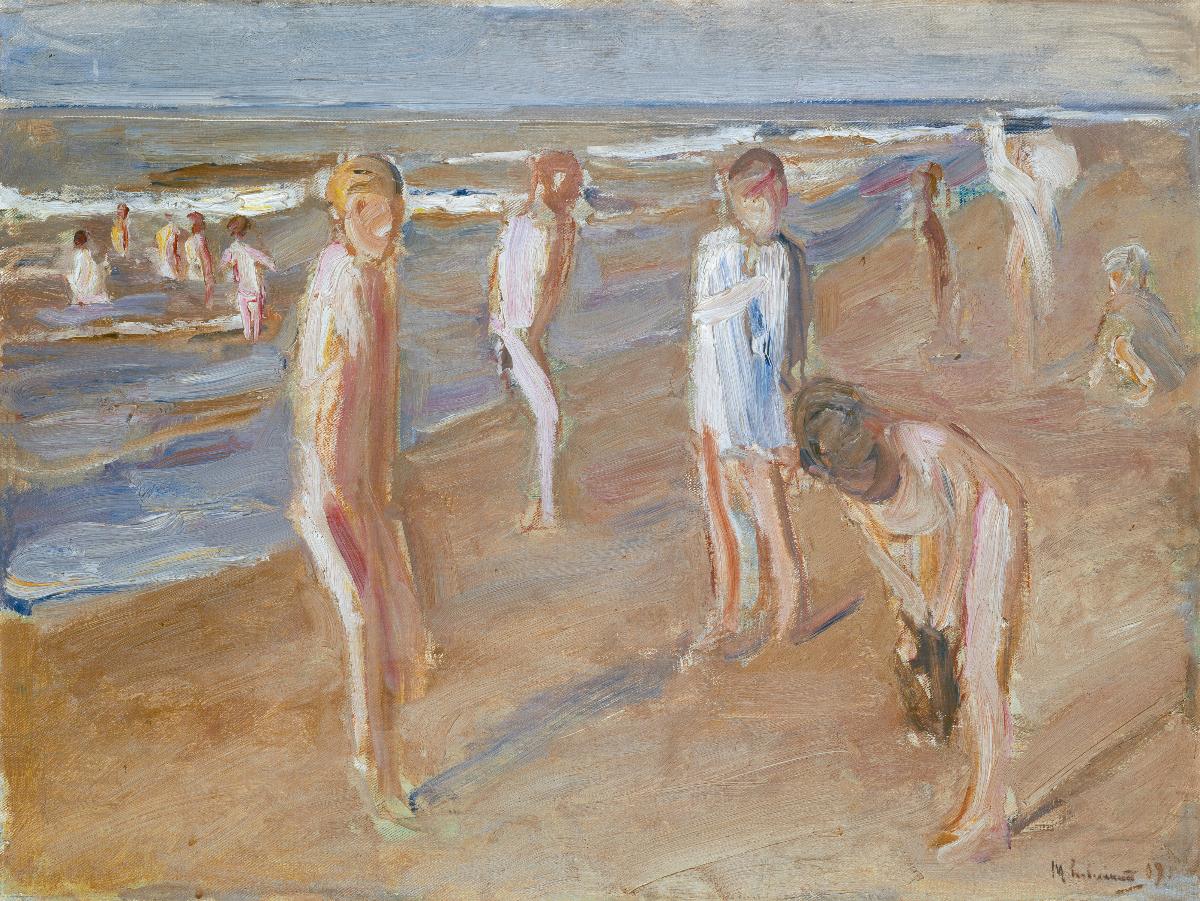
This was a departure. French Impressionists had already painted bathers — Renoir’s luminous nudes, Degas’s keyhole compositions — but their figures still carried studio DNA. Renoir’s bathers in Les Grandes Baigneuses are arranged like a classical frieze; Degas’s women, however private, are frozen in a choreography of the unobserved. Liebermann’s beach figures are different: they’re not being watched, and they don’t know we’re here.
The painter doesn’t need to paint what he sees in front of him. He needs to paint what he sees inside himself. But if he can see nothing inside himself, he should also not paint what he sees in front of him.
— often attributed to Liebermann, paraphrasing his philosophy on painting from experience
What the Beach Does to the Body
There’s a specific kind of truth that only the beach can extract from the human figure. The studio nude is weightless; it floats in abstract space with its mythological passport. The beach nude has weight. Feet sink into sand. Skin prickles in wind. The body is exposed not just anatomically but meteorologically — it has to contend with temperature, light, the salt-sting of sea air.
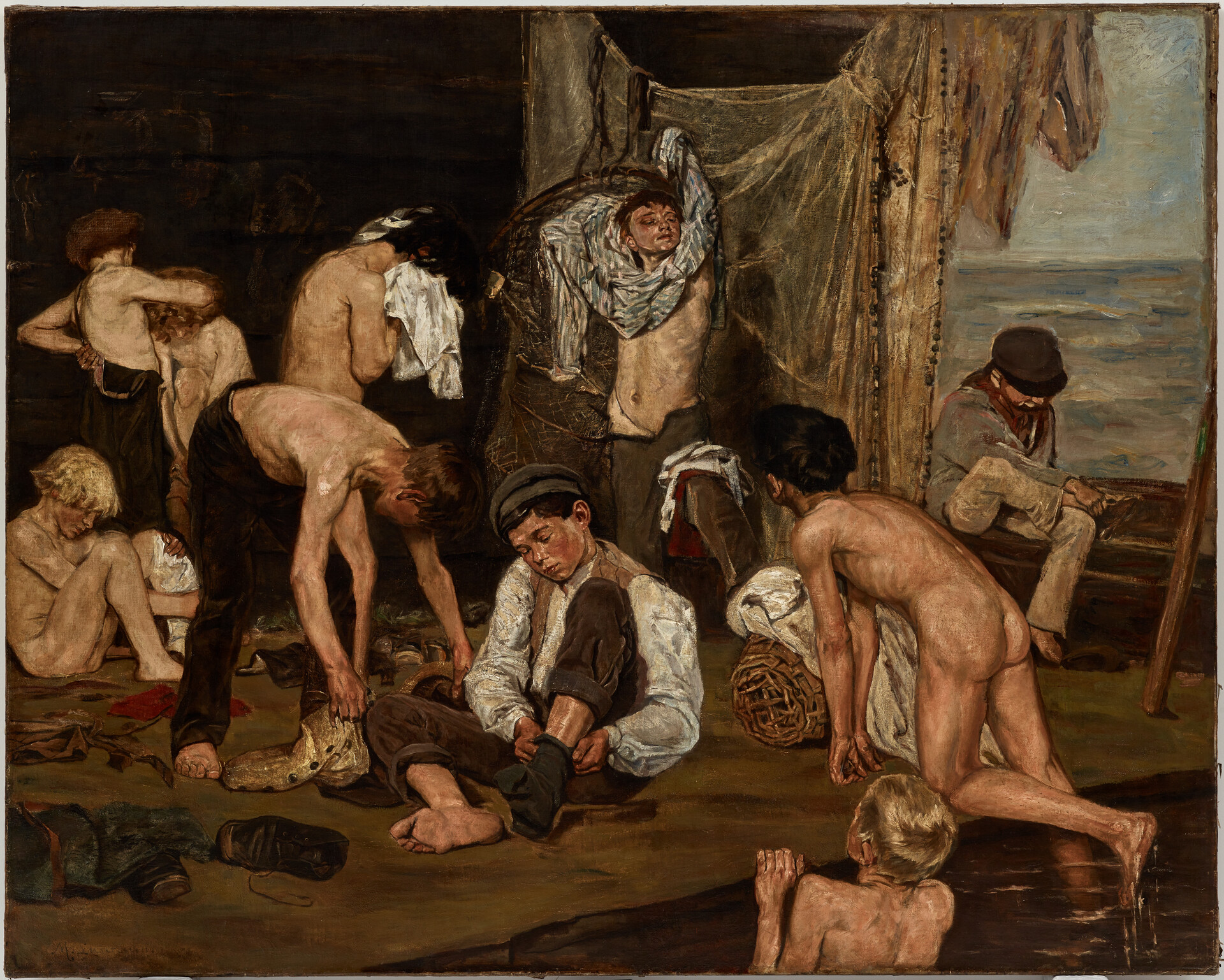
Liebermann understood that the beach solves a problem the nude had been wrestling with for four centuries: how do you show a naked body without it becoming an object on display? The answer, he proposed, is to put it somewhere real. When a figure has to worry about the cold North Sea, it stops worrying about whether you’re looking.
This was a distinctly German contribution. Where the French Impressionists dissolved the nude into light (Renoir) or froze it into an unguarded moment (Degas), Liebermann’s innovation was context. The nude body wasn’t the subject — the relationship between the body and the world around it was. That’s a philosophical shift, not just a stylistic one.
The Body Erased
And then came the Nazis.
Liebermann was Jewish. When he watched Nazi stormtroopers march through the Brandenburg Gate in 1933, he is said to have remarked, “I cannot eat as much as I would like to vomit.” He resigned the presidency of the Prussian Academy before they could force him out. He died in 1935, spared the worst of what was coming, but his art was not.
The Nazi campaign against “degenerate art” — Entartete Kunst — targeted Liebermann’s work along with that of Kirchner, Nolde, Pechstein, and every other artist who had treated the human body as something more complicated than an Aryan ideal. His paintings were confiscated from museums, sold abroad for foreign currency, or destroyed. The painter who had given Germany its first modern beach nude was declared an enemy of the German body.
Why It Matters Now
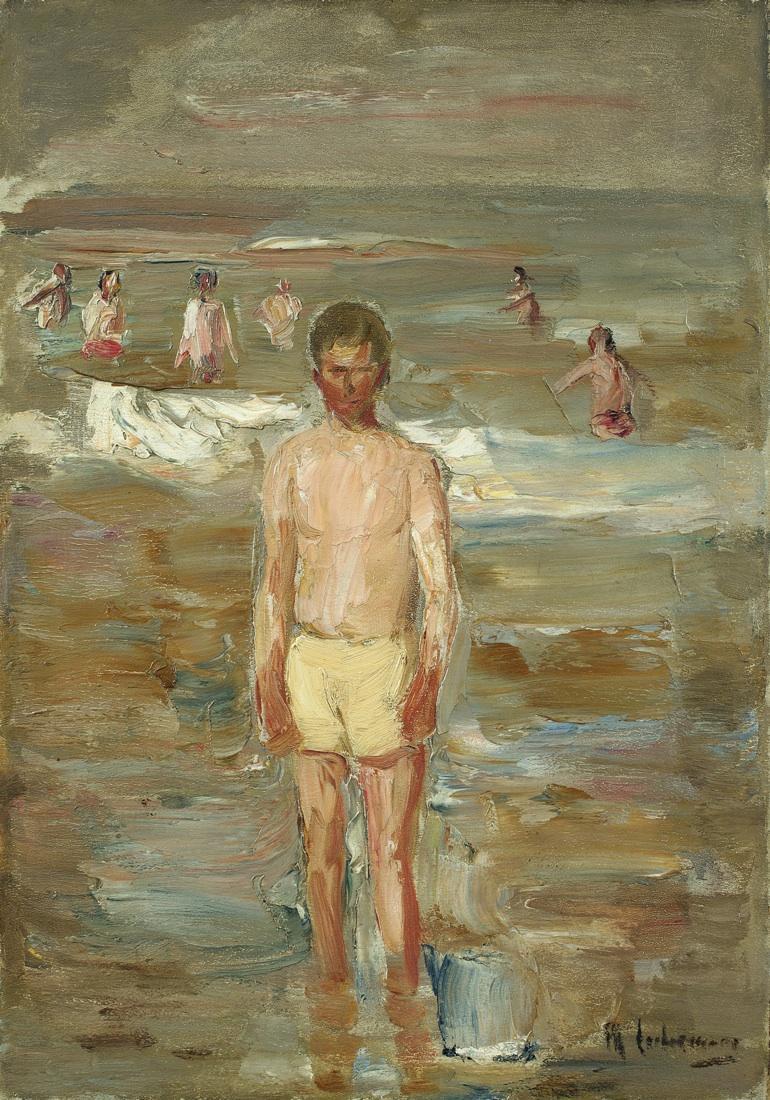
Liebermann’s beach figures ask a question that’s still live in 2026: what happens to the nude body when you take away the alibi? No goddess. No nymph. No historical costume. Just a person at the edge of the land, absorbed in the business of being alive.
This is the question that runs from Liebermann through Eakins through Mapplethorpe through every contemporary artist who puts the nude body in a real place and dares you to call it anything other than what it is. The German salon nude was a proposition: this body is art because I say so. Liebermann’s beach nude is the answer: this body is art because it exists.
One hundred and seventy-nine years after his birth, Liebermann is still remembered mostly for his gardens and his portraits. But if you want to understand what he really did — the quiet shift in how Western art thought about the human figure — look at the beach. Look at the boys wading into the cold water. They’re not posing for you. They’re not performing. They’re just there. And that, Liebermann proved, is enough.