When you stand before a Renaissance nude — a Michelangelo ignudo twisting against the Sistine ceiling, a Leonardo study of sinew and bone — you are not looking at an idea. You are looking at the residue of a secret. Before the nude became a genre, a symbol, a scandal, it was a dissection. And for the artists who built the Western tradition, learning to draw the body meant learning to open it.
This is the part of art history that gets sanitized in museum wall texts. We talk about “the rediscovery of the classical nude” and “the harmony of human proportion” as if artists simply looked at Greek statues and figured it out. They didn’t. They went into crypts at midnight. They paid gravediggers. They stood for hours in the stench of opened corpses, charcoal in hand, sketching the architecture of muscle and bone before the Church could find out.
The nude in Western art was born in a dissection theater. And understanding that changes everything about how we see it.
The Body Underground
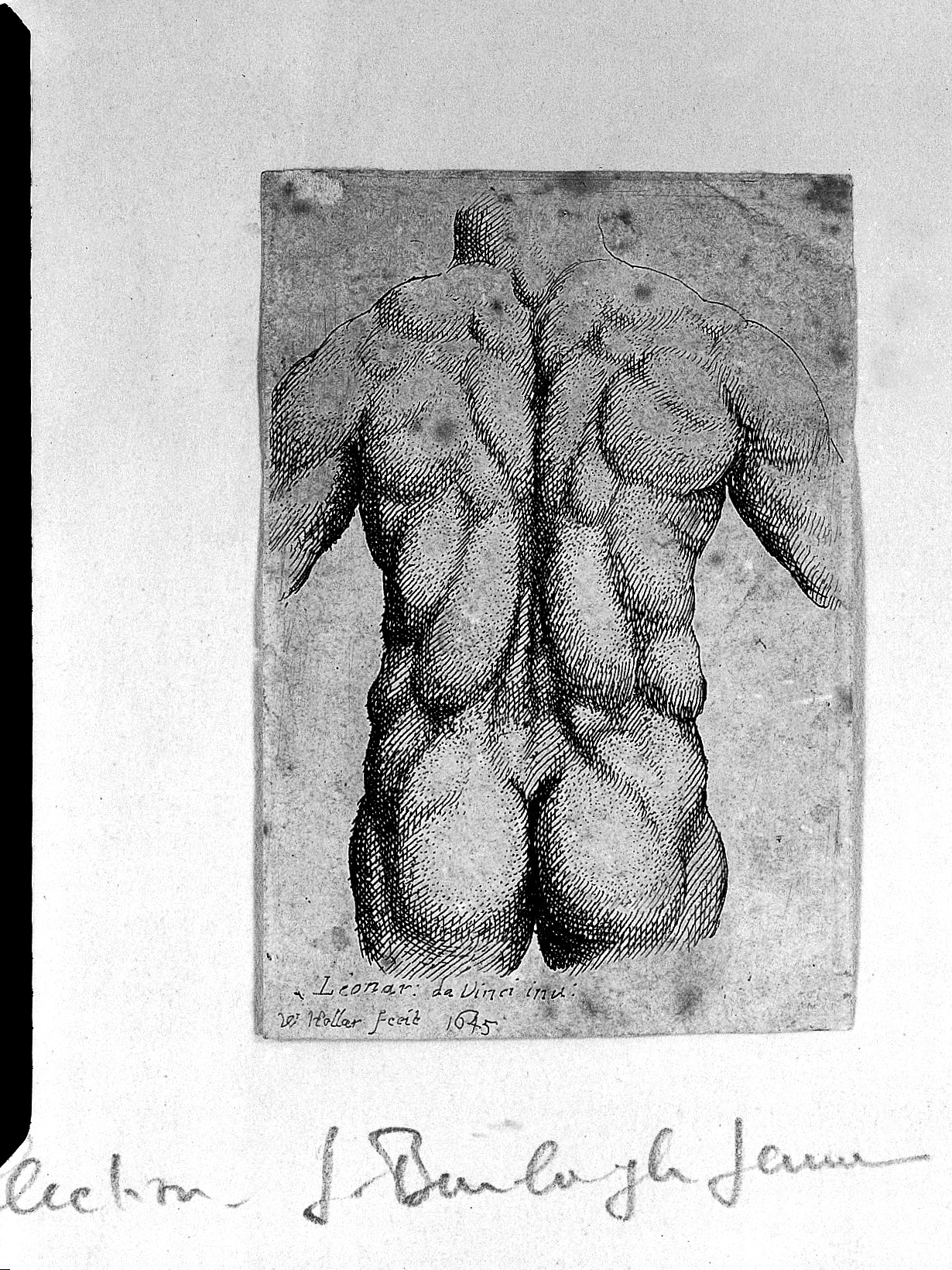
Leonardo da Vinci dissected more than thirty human corpses. He did this at night, in hospital morgues, under conditions that were medically dangerous and legally ambiguous. He was not a physician — he was an artist trying to understand why the deltoid swells the way it does when an arm lifts, or how the tendons of the hand connect to the forearm. His anatomical notebooks contain over 240 drawings and 13,000 words of observation. They are arguably more rigorous than any medical text of the era.
And the Church was not pleased. When Leonardo died in 1519, his anatomical papers were scattered and lost for centuries. The reason was simple: cutting open human bodies was considered desecration. The Renaissance artist’s relationship with the nude was, from the beginning, an act of transgression. The body on the canvas was downstream of the body on the table.
Vesalius and the Artist-Anatomist
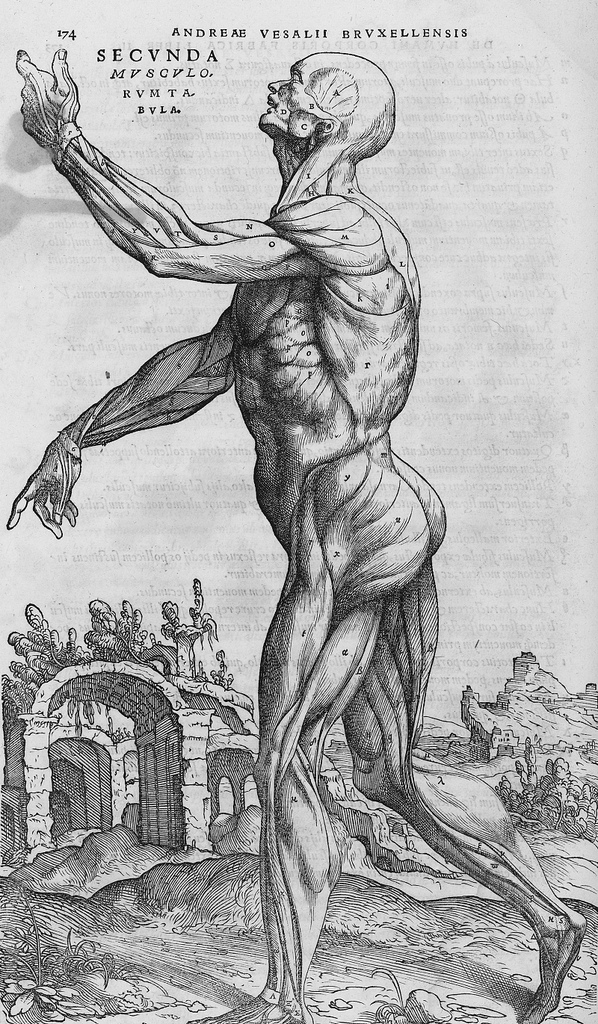
In 1543 — the same year Copernicus published his heliocentric model of the universe — Andreas Vesalius published De Humani Corporis Fabrica (On the Fabric of the Human Body). It was a revolution in anatomy, correcting centuries of Galenic error. But it was also a revolution in art. Vesalius hired artists from Titian’s workshop to produce the woodcuts, and the result is one of the strangest and most beautiful books ever made: flayed figures posed like classical sculptures, skeletons leaning on spades as if they were shepherds in an Arcadian landscape, muscle-men standing in contrapposto against Renaissance landscapes.
These illustrations — often called the “muscle men” — are not neutral diagrams. They are aesthetic objects. They borrow the language of the nude from classical antiquity and fuse it with the language of the dissecting table. The result is a new kind of image: the body as both scientific specimen and artistic subject. The boundary between the life room and the anatomy theater had dissolved.
Michelangelo and the Price of Knowledge
Michelangelo Buonarroti began dissecting bodies as a teenager, trading drawings for access to the corpses at the Santo Spirito monastery in Florence. He was probably the most anatomically knowledgeable artist who ever lived. His figures on the Sistine Chapel ceiling — the ignudi, the prophets, the sibyls — are not idealized abstractions. They are translations of real muscle groups, real tendon paths, real skeletal structures, pushed into impossible torsion to express spiritual drama.
But the knowledge came at a cost. Michelangelo’s biographer Ascanio Condivi wrote that the artist eventually gave up dissection because “the long contact with corpses so disturbed his stomach that he could neither eat nor drink.” The nude body on the Sistine ceiling, which millions of visitors now gaze up at in air-conditioned reverence, was built on a foundation of physical disgust and moral risk. Every twisted torso is a record of something the artist saw that he was not supposed to see.
What This Means for How We Look
Understanding the dissection-room origins of the Renaissance nude changes the way we encounter these images. They are not just beautiful. They are hard-won. The smooth marble surface of a Michelangelo slave, the precise cross-hatching of a Leonardo muscle study — these are not effortless. They are the product of nights spent in crypts, of hands that had touched what most people never touch, of a willingness to break rules in pursuit of truth.
This is also why the nude in Western art carries a charge that still hasn’t dissipated after five hundred years. The nude is not merely the body without clothes. It is the body known — known from the inside out, known through a process that was forbidden, known at a depth that makes the surface seem almost incidental. When you draw the nude from a model today in a well-lit studio with a space heater and a timer, you are the beneficiary of a tradition built in darkness, built in secrecy, built by people who risked excommunication and worse to understand what a shoulder blade looks like when the skin is removed.
The next time you see a Renaissance nude, remember: someone opened a body so you could see this. The beauty is real. But so is the cost.
— NALA Editorial