On August 30, 1748, Jacques-Louis David was born in Paris. He grew up to become the painter of the French Revolution, the official image-maker for Napoleon, and the artist who dragged the nude out of the boudoir and handed it back to politics.
Before David, the Rococo dressed the body in satin, powder, and delicate evasion. Fragonard and Boucher painted flesh as a playground for aristocrats. David stripped it bare and made it mean something else entirely. For him the naked body was the uniform of virtue. The ancient Greeks and Romans, he insisted, painted their heroes nude because the bare body was the honest body: the civic body with nothing to hide.
The Sabine Women, Painted Naked on Principle
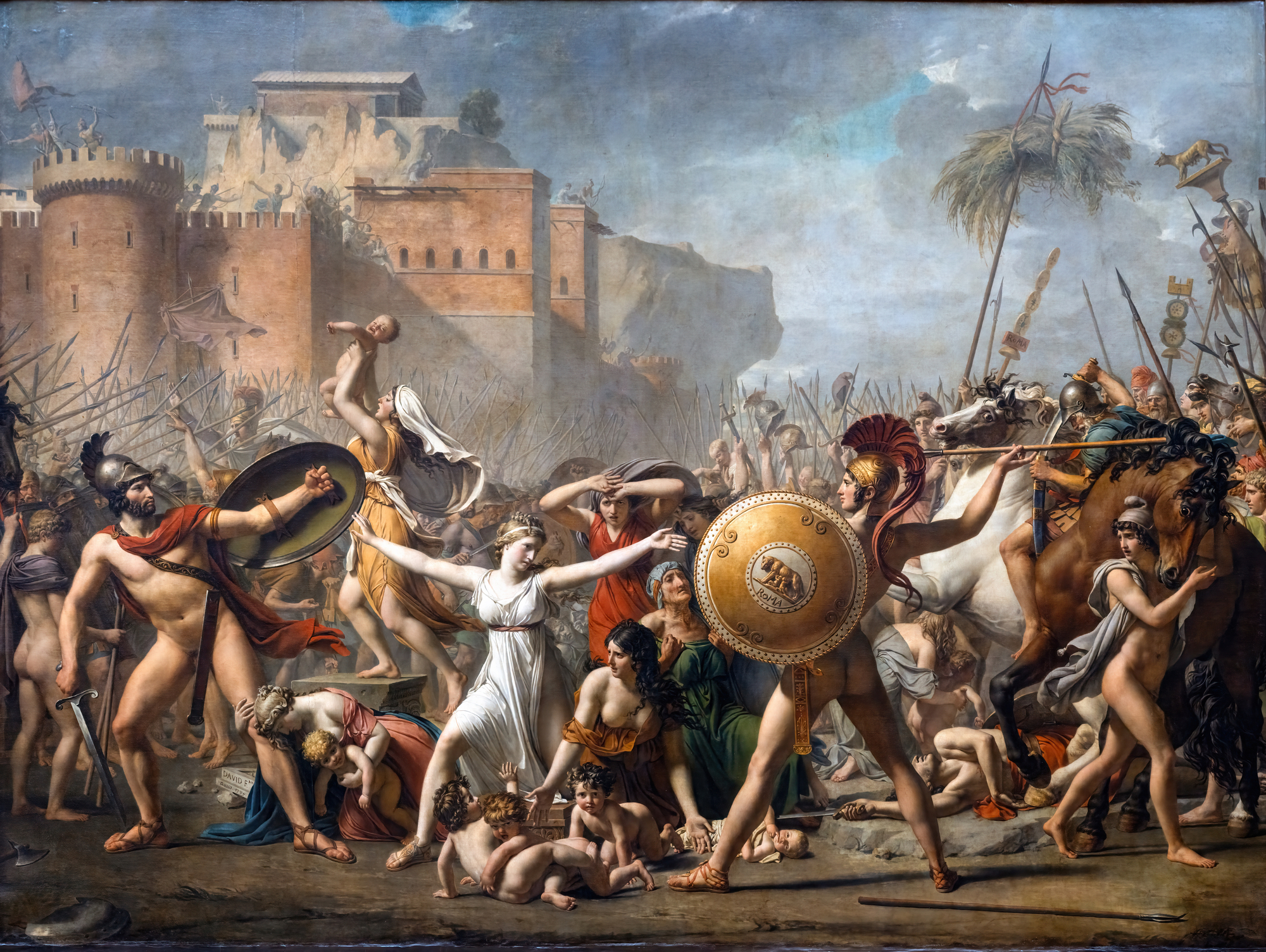
His 1799 painting The Intervention of the Sabine Women is the clearest statement of that belief. The Roman warriors stand almost entirely nude, their bodies arranged like a frieze from antiquity. David exhibited the work with a written defense, explaining that he painted his figures naked the way the ancients had, because the body itself carried the meaning.
The choice was deliberate and a little defiant. He wanted the nude to read as classical, heroic, and civic, and he was prepared to argue for it in print.
The Body as Political Grammar
David spent his career using the human body as a political language. In The Oath of the Horatii, the brothers’ bare arms and tensed legs speak of patriotic sacrifice. In The Death of Marat, the martyred revolutionary hangs from his bath with a torso borrowed from a Pietà, turning a journalist’s murder into a sacred event. The body, half-clothed or fully naked, became the grammar through which David argued about liberty, duty, and the state.
The Nude Is Never Neutral
What David grasped, and what still holds, is that the nude is never a neutral subject. Every era decides what the bare body means. For the Rococo it meant aristocratic leisure and erotic play. For David it meant virtue, courage, and civic duty. For us it is contested once again, in advertising, in social-media moderation, in the arguments over what a museum may show.
The nude is a language, and whoever controls the body controls the message. David understood that better than almost anyone before or since.
Born 278 years ago today, he dressed his heroes in nothing but virtue and proved that the naked body is one of the most powerful political instruments an artist can hold.