Born Into the Age of the Naked Hero
Caspar David Friedrich was born on September 5, 1774, in Greifswald, a Baltic port town that then belonged to Sweden. He grew up to become the most important German painter of his generation, and he did it by attempting something almost no serious artist of his era would dare. He turned the human body away from the viewer, wrapped it in a coat, shrank it to a speck against an enormous sky, and let the landscape carry the meaning.
To grasp how radical that was, remember what the body meant in European painting around 1800. The academy taught that the naked human figure was the highest subject an artist could attempt. Jacques-Louis David and his Neoclassical school, a generation older than Friedrich, made the heroic nude the grammar of civic life: large, ideal, and fully on display. The body was a monument to reason and virtue.
Friedrich rejected all of it. He painted the body as a mystery rather than a monument.
The Back Figure
His signature invention was the Rückenfigur, the “back figure.” In Wanderer above the Sea of Fog, his most famous image, a lone man stands on a rocky crag, seen entirely from behind, facing a sea of mist that swallows the horizon. We never see his face. We never see his skin. He is a dark vertical mark against the fog, an anonymous stand-in for anyone who has ever stood at the edge of something too large to name.
The genius of the back figure is that it invites us in. Because we cannot see the wanderer’s face, we project our own onto it. The figure becomes a doorway, and the viewer steps through it into the landscape. Friedrich understood that a body you can look at is a body you can own, and a body turned away is a body you have to meet on its own terms.
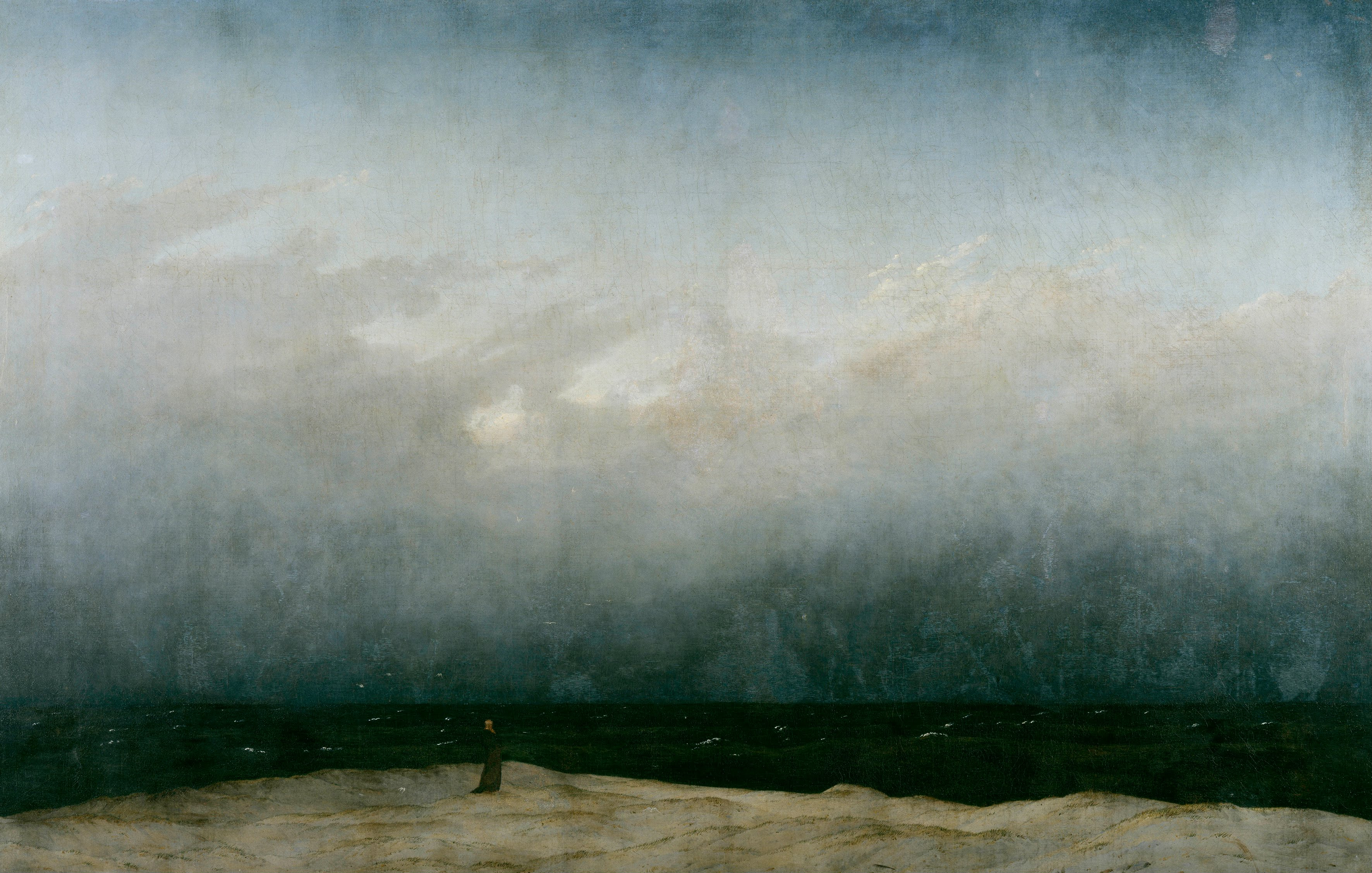
In Monk by the Sea the figure is smaller still. Friedrich reduces the picture to three horizontal bands of sea, sky, and shore, then places one tiny figure at the center of it all. The sky takes up most of the canvas. The body is nearly an afterthought, and that is the point. Against the infinite, a human being is very small, and Friedrich believed that truth was more honest than any idealized Apollo.
Here was the philosophical break. The Neoclassical nude promised that the body could be perfect, rational, and knowable, a mirror of divine order. Friedrich’s figures promised the opposite. The body, for him, was finite, fragile, and turned away from us, a consciousness facing something it could never fully comprehend. The body became a question instead of an answer.
The Woman Who Faces the Light
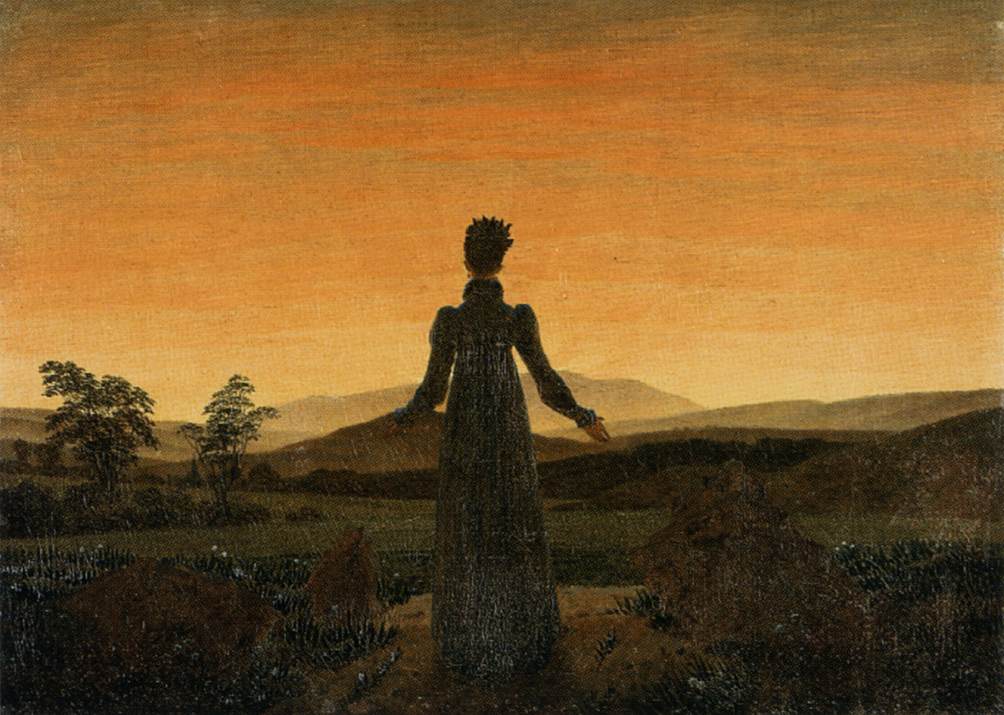
Friedrich painted women, too, and with the same restraint. In Woman before the Rising Sun, a woman stands in an open field, her arms raised, her back to us, greeting the sunrise. She is no Venus. She is not arranged for the viewer’s pleasure. She is a worshipper, and the light she faces outshines her. Friedrich grants the female body a different kind of dignity, one that comes from devotion rather than desirability.
The Legacy of the Small Body
This turn away from the nude outlived Friedrich himself. When he died in 1840 he was nearly forgotten, his reputation buried along with the Romanticism he had helped invent. The twentieth century brought him back. The Symbolists adored his landscapes of the soul. The Surrealists claimed him as an ancestor. And the abstract painters who came later, the ones who dissolved the figure entirely into fields of color, were completing a job Friedrich started: shrinking the body until only the feeling of the infinite remained.
Friedrich’s lesson is worth holding onto in a world that still argues about the naked body in art. The nude is one way to make the body meaningful. It is not the only way. Friedrich proved that a figure with its face turned away, its skin hidden, and its scale reduced almost to nothing could still carry the full weight of what it means to be human.
Join us as we explore the human figure in art, in every form it takes.