For most of Western art history, the nude needed an alibi. A naked woman on canvas was Venus rising from the sea, or a nymph fleeing Actaeon, or an allegory of Truth. The body had to stand for something else, a costume for an idea. Henri de Toulouse-Lautrec, who died on September 9, 1901, at the age of thirty-six, refused the alibi outright.
He painted the women of the Parisian brothels, the maisons closes of Montmartre, as they were: resting between clients in the salon, lining up for a routine medical inspection, dozing, talking, adjusting a stocking. These are working women, and no mythology enters the room to soften that fact. He painted them with a tenderness and a lack of judgment that still feel radical a century and a quarter later.
The salon with no pose
“Au Salon de la rue des Moulins” (1894) is the masterpiece of this approach. A row of women sits on padded benches in the brothel’s salon, waiting, their faces a study in boredom and patience and private thought. Nobody performs for the viewer. The women are absorbed in their own thoughts, and that refusal to pose is the painting’s whole power.
Toulouse-Lautrec knew these rooms from the inside. He moved into the brothels for weeks at a time, a resident rather than a visitor. The women called him by name, and he returned their acceptance with attention. That intimacy, the artist present without the distance of a client or a judge, is what lets the painting read as testimony instead of spectacle.
The body under inspection
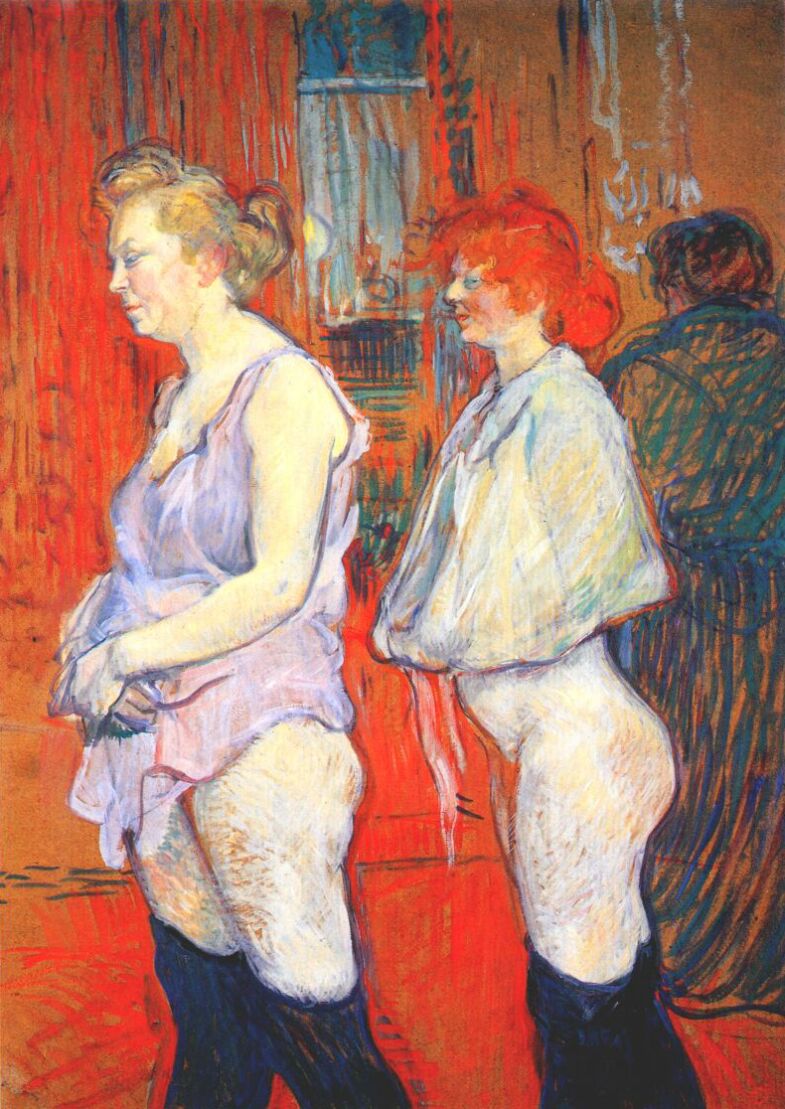
“The Medical Inspection” (1894) goes further. The women stand in line, chemises lifted, for a doctor’s routine examination, a moment of bureaucratic vulnerability he renders without melodrama. It inverts the academic nude. Where the Salon tradition perfected the female body into an ideal, Lautrec records the real body under real institutional power.
Affection and exhaustion
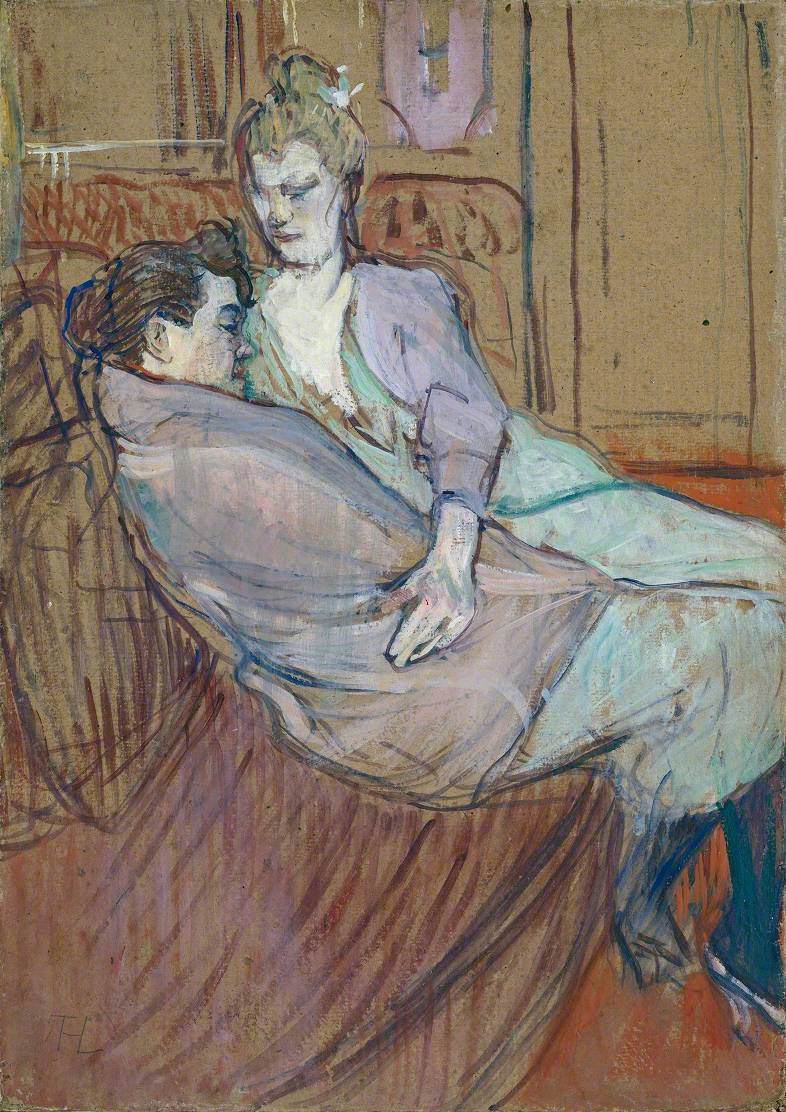
“Les Deux Amies” (The Two Friends, 1895) catches two women in a private moment, one resting her head against the other, a gesture of affection braided with exhaustion. There is warmth in it, and weariness, and a kind of solidarity the polite art world of 1895 had no category for.
An aristocrat on the margins
Lautrec was born into the French aristocracy, the first child of the Comte and Comtesse de Toulouse-Lautrec-Monfa. A congenital condition, compounded by two adolescent accidents that fractured his legs and left them stunted, kept his body small. He was an outsider in his own class, and he spent his short life on the edges of Paris, in the cabarets, dance halls, and brothels of Montmartre, drawing with a draftsman’s speed and an outsider’s eye.
He trained in the academic studios of Bonnat and Cormon, where the nude was a discipline and the model an object. He absorbed the technique and discarded the ideology. His nudes close the distance the academy insisted on. They replace the ideal with the real and the goddess with the woman, and they anticipate a century of art that would ask harder questions about who gets to be looked at, and on whose terms.
What he left behind
Lautrec died at thirty-six, at the family château of Malromé, worn out by alcoholism and syphilis. He left behind posters, lithographs, paintings, and a record of bodies the polite art world preferred not to look at. He neither celebrates nor condemns the brothel. He pays attention, and he lets the women he knew remain themselves.
We still argue about the nude as if it were a single thing, one fixed tradition with one fixed meaning. Lautrec is the proof that it was always many things. He asked a harder question than whether the body can be beautiful. He asked whether the body can be true.